Stellar FabricThe source has to match the geometry
More precise calculations, two exterior regions, and a pressure mismatch that narrows the search.
By Stan Schneider
Published
Source, stress and geometry
Conceptual geometry · not a computed solution
THE NEXT CALCULATIONS
What holds up under closer tests?
We calculated the energy density and both pressures of a quantum field on a geometry with two exterior regions, then compared them with the stresses that geometry requires. The transverse pressure has the opposite sign. Changing the source strength or the nearby shape did not produce a consistent solution in the cases examined. Earlier calculations also became more precise, allowing a clearer comparison between a periodic thermal model and this new boundary problem.
RESEARCH STATUS
These are finite-model results. The tested zero-temperature source does not support the prescribed two-ended geometry. A complete exterior quantum source, controlled regulator removal, joint equilibrium and stability remain unresolved. No physical wormhole has been established.
The previous update describes the thermal-state calculation. Its results and assumptions remain available alongside this work.
SIX FINDINGS · EQUATIONS & CHECKS
The calculation and what it tells us.
Each result shows what we compared, the checks we made and the limits of the answer.
Notation and units are defined for each result. Numerical checks apply to the stated model and approximation. Long equations scroll within their own blocks on small screens.
The periodic calculation survives a closer numerical check.
Two finite thermal candidates · fixed action and coefficients
We improved the evaluation of local curvature terms and repeated the grid comparisons. Both tested periodic thermal candidates now meet the selected numerical checks. Their remaining mismatch with Einstein’s equations is larger than the measured grid change.
Established starting point
Heat-kernel subtraction supplies the local curvature terms. Their numerical evaluation must be accurate enough to distinguish cancellation error from a source that fails to fit the geometry. [1] [2]
What we derived or checked
At the two retained cutoffs, the measured grid difference fell by factors of about 21 and 103. We kept the finite action and candidate coefficients fixed.
(01.1)
G is the Einstein tensor, T the model stress tensor and κ its gravitational coupling. N and M label two spatial grids. All quantities use the same normalized model units; ε is the retained regulator parameter. The norms are positive volume norms of the three independent components: ‖Y‖²=∫4πr²dl(Yρ²+Ypr²+Ypt²), not a Lorentzian contraction. Gref is held fixed in each grid comparison.
Tests & outcome
Checks for result 01: Separate numerical error from model mismatch
Check
Result
Full-tensor residual
Rfull≈1.15×10⁻⁶ at ε=0.06 and 1.18×10⁻⁶ at ε=0.03. The corresponding grid changes are about 0.245% and 0.176% of those residuals.
Precision and remaining target
Higher precision was used for local terms and selected spectral checks, not the entire quantum calculation. A separate 10⁻¹⁰ projected optimization target was not reached.
Derivation & model scope
Evaluate local subtraction terms with greater arithmetic precision, without changing the finite model.
Compare matched grids, then measure the remaining full-tensor mismatch separately.
These are eight-harmonic periodic thermal approximations at two finite cutoffs. Agreement on finer grids does not remove the regulator or prove a continuum solution.
A smaller numerical error makes the physical mismatch easier to measure; it does not remove that mismatch.
What remains unresolvedThe residual is still nonzero. Regulator removal and the complete unprojected equilibrium require further work.
02
Exterior geometry
Smooth exterior geometry can be built before its source is solved.
Prescribed smooth geometry · explicit Maxwell sector · zero temperature
The periodic interior cannot be attached directly to an empty Schwarzschild exterior at the tested cuts: the boundary pressure does not match. With an explicit Maxwell field, we constructed smooth geometries with two Reissner–Nordström exterior regions and no exterior horizon in the tested families. This supplies a geometric target for a new source calculation.
Established starting point
The spherical Einstein–Maxwell equations fix how boundary radius, lapse and their derivatives relate to exterior mass and electric flux. Two-ended flux geometry is an established idea. [3] [4]
What we derived or checked
We applied those relations to the retained finite profiles and constructed smooth transitions to both exterior regions. We then treated the changed quantum state and boundary domain as a new problem.
(02.1)
Use ds²=−N(l)²dt²+dl²+r(l)²dΩ², with proper distance l, q=dr/dl and A=d ln N/dl. R is the matching radius; M and e are the geometrized Reissner–Nordström mass and charge parameters, in model units.
Tests & outcome
Checks for result 02: Connect the geometry to two exterior regions
Check
Result
Matching and smooth transitions
For the two finite profiles, |q+AR|<0.125 throughout the open half-period cuts examined analytically. The largest adaptive endpoint mismatch in the transition tests was about 3.58×10⁻¹².
An unresolved numerical control
Twenty of 72 scalar-curvature reconstruction cases missed the strict 10⁻¹¹ absolute target. The geometric construction does not certify those curvature evaluations.
Derivation & model scope
Match radius and lapse data to a charged exterior while keeping the Maxwell sector explicit.
Construct smooth transition regions and check their endpoints and exterior horizon condition.
The coefficient bound applies to the retained finite profiles and open cuts. It is not a bound on omitted harmonics or a uniform lapse margin at limiting endpoints. The completed geometry is prescribed; its quantum source has not been solved jointly with it.
The thermal periodic state and the zero-temperature two-ended boundary problem have different assumptions.
What remains unresolvedThe source must be recomputed on the completed domain. A successful geometric attachment alone cannot establish equilibrium.
03
Energy requirement
The Maxwell field leaves the negative radial-null-stress requirement in place.
An electric field changes the exterior matching, but its radial energy density and pressure sum to zero. A canonical static scalar contributes a nonnegative sum. The negative radial-null stress required by the throat must therefore come from the remaining quantum sector in this model.
Established starting point
The null-energy requirement for a traversable throat and averaged null-energy integrals are established results. We used them to check the completed profiles and to separate the roles of their fields. [5]
What we derived or checked
We derived the proper-distance form of the stress budget and evaluated the affine null integral. We also kept it distinct from the radius-weighted integral, which has a different normalization and meaning.
(03.1)
(03.2)
ρ and pr are total orthonormal energy density and radial pressure. N→1 at both exterior infinities; the radial null ray has unit Killing energy. For the canonical scalar χ, ρχ+pr,χ=(dχ/dl)²≥0; for the radial Maxwell field, ρEM+pr,EM=0.
Tests & outcome
Checks for result 03: Identify which field must supply the negative stress
Check
Result
Affine null integral
The tested completed geometries give IANEC between approximately −5.26×10⁻⁴ and −5.07×10⁻⁴ in the stated model normalization.
Separate weighted identity
The radius-weighted integral ∫r(ρ+pr)dl/N=−4/κ≈−1.05×10⁻³. It is not the affine ANEC integral above.
Derivation & model scope
Combine the spherical energy-density and radial-pressure equations in proper distance.
Integrate with the two asymptotic normalizations and vanishing endpoint terms.
These identities constrain the source a geometry would need. Their negative sign does not demonstrate a quantum state that supplies it.
The project contribution is the application and numerical evaluation for these profiles, not a new null-energy law.
What remains unresolvedA quantum source must meet the required tensor components while retaining a controlled physical state and subtraction prescription.
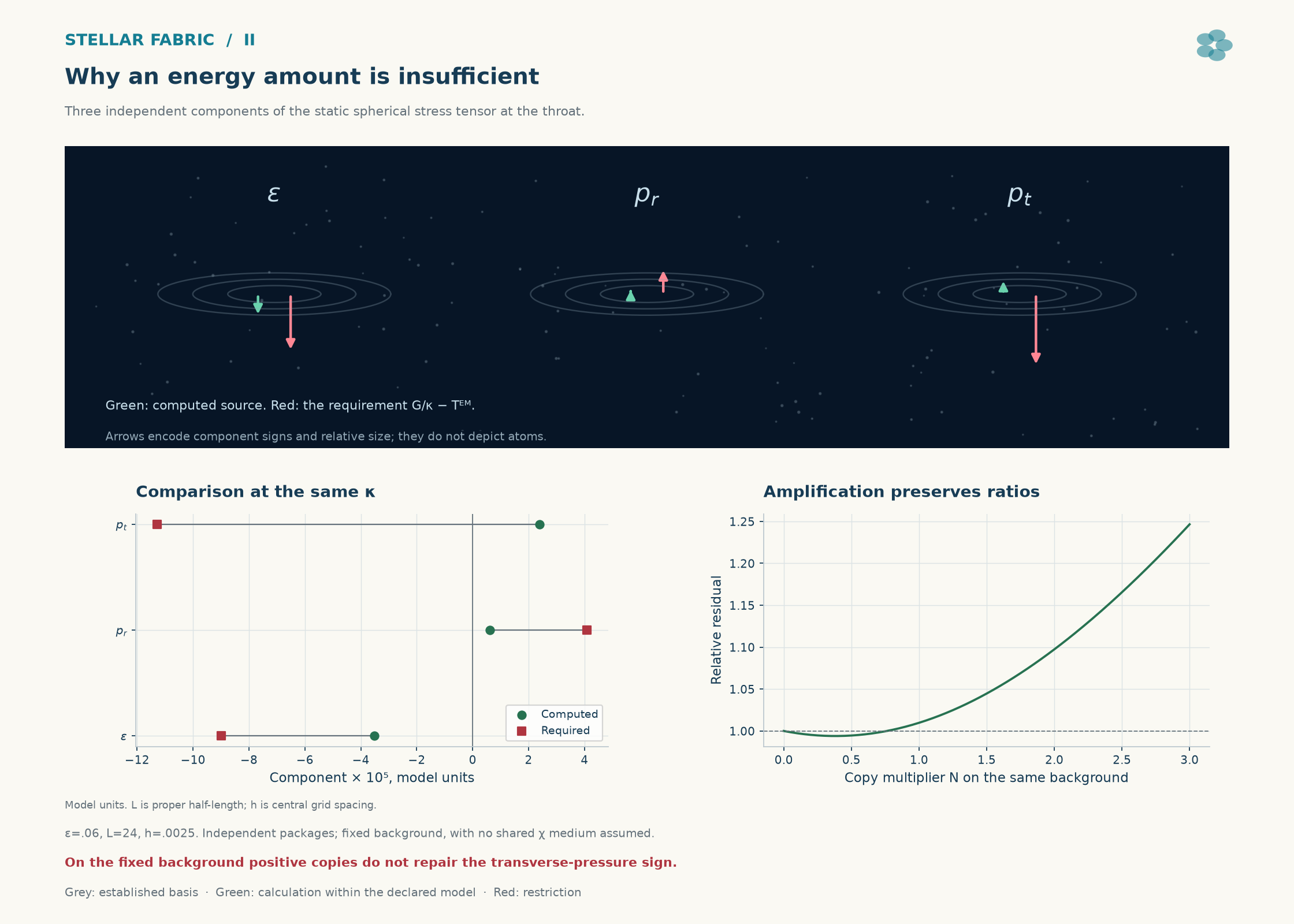
We calculated all three static source components independently and compared them with the non-Maxwell stress required by the prescribed geometry. At the throat, the energy density is negative, but the transverse pressure is positive where the geometry requires it to be negative.
Established starting point
A stress tensor is obtained by varying the same effective action with respect to independent metric components. Conservation alone does not determine both pressures. [6] [1]
What we derived or checked
For one neutral Gaussian scalar with its retained mean fields, we compared S=(ρ,pr,pt)Q+χ with T=(G/κ−TEM) in a local orthonormal frame. We then tested whether a common positive multiplier could repair the central component ratios.
(04.1)
All three central components use units ℏc/ℓ*⁴. Q denotes the Gaussian quantum sector and χ the retained classical mean-field contribution. The multiplier a is a continuous fixed-background diagnostic, not an integer species count or a new many-species action.
Tests & outcome
Checks for result 04: Compare energy density and both pressures
The best common multiplier is about 0.381, leaving 99.4% relative mismatch in this central three-component comparison. Positive amplification preserves the wrong transverse-pressure sign.
Derivation & model scope
Evaluate density and both pressures from independent variations of the declared finite functional.
Subtract the explicit Maxwell stress from the geometric requirement and compare like components at the throat.
The comparison uses ε=0.06, proper half-length 24 and central grid spacing 0.0025 in model units, with fixed local counterterms. The 99.4% number is a central tensor mismatch, not numerical error or a regional norm. The domain and state differ from the earlier periodic thermal calculation.
Negative energy density is only one part of the required stress tensor.
What remains unresolvedThis source on this prescribed background fails the support test. The result does not exclude every quantum source or every wormhole geometry.
The source and the required stress. The transverse-pressure signs disagree. The upper panel illustrates component signs; the lower panels show the numerical comparison and the common-scaling test. This is a finite-model source calculation, not an observed geometry.Open full-size research figure ↗
05
Geometry feedback
The same central curvature can produce a different quantum response.
Paired compact deformations · fixed exterior and flux
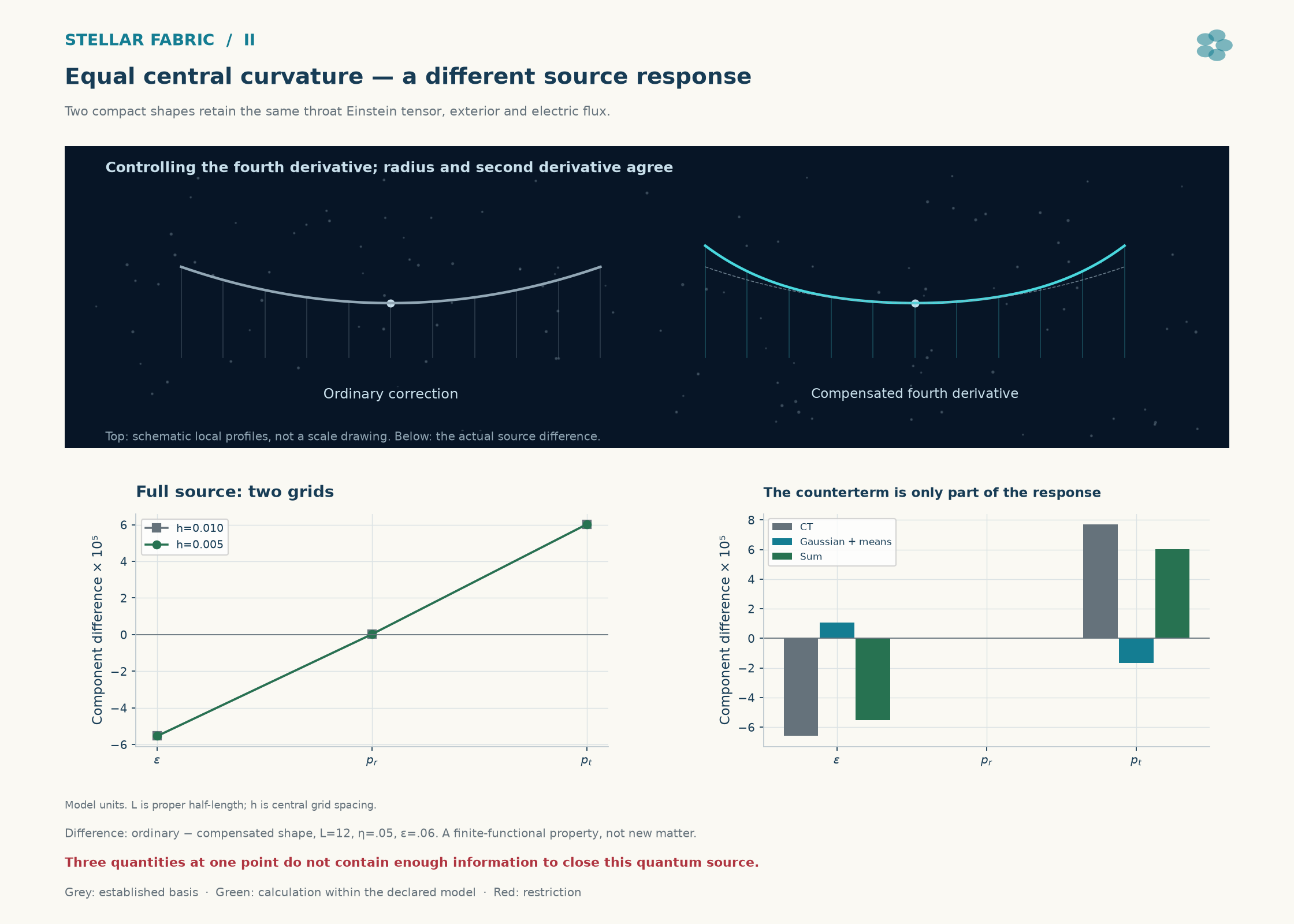
We compared two shapes with the same throat radius, lapse and their first two derivatives. Their required central Einstein tensor agrees, but their calculated quantum source differs. A separate shape correction improved the central mismatch while making the surrounding region much worse.
Established starting point
Curved-space quantum stress depends on the field operator, state, boundary conditions and local subtraction terms. The central Einstein tensor alone does not specify that quantum problem. [1] [6]
What we derived or checked
We changed the compact profile while preserving its lower central derivatives, recalculated the complete retained source, and checked the residual across a finite central region rather than at one point alone.
(05.1)
c=ln r; B is a smooth compact window, with B(0)=1. η controls the perturbation, c* its amplitude scale and Ls its length scale. The whole compact profile changes, not just a fourth derivative at one point.
Tests & outcome
Checks for result 05: Test more than the value at the centre
Check
Result
Paired central source difference
Ordinary minus compensated shape gives Δ(ρ,pr,pt)≈(−5.54×10⁻⁵, +2.20×10⁻⁷, +6.02×10⁻⁵), although the central geometric requirement is unchanged.
A centre-only improvement fails regionally
In one separate trial, the central maximum component residual fell from 1.39×10⁻⁴ to 1.23×10⁻⁴, while the maximum over |l|<1.8 rose from 3.74×10⁻⁴ to 0.291. No corrected solution was accepted.
Derivation & model scope
Preserve radius, lapse and the derivatives entering the central Einstein tensor while changing a smooth compact neighbourhood.
Recompute the source and compare both the throat and the surrounding residual.
The paired source values use grid spacing 0.005; the unsuccessful regional correction uses 0.01. Its refinement did not establish an accepted converged repair. The comparison does not isolate one derivative as the sole cause or prove a new locality theorem.
The source and geometry must agree as functions across the domain.
What remains unresolvedGeometry feedback must improve the full region and pass refinement checks. A better value at the throat is insufficient.
Equal central curvature, different source response. The profiles preserve the central geometric requirement but change the quantum source. The shapes above are schematic; the plots below show the calculated component differences and the contributions to them.Open full-size research figure ↗
06
Physical interpretation
The current normalization does not provide a low-curvature physical scale.
A dimensionless numerical radius cannot be assigned an arbitrary macroscopic size while leaving the gravitational coupling unchanged. Under the canonical single-source identification with Newton’s constant, this candidate has a sub-Planckian throat radius. That identification does not give the separation of scales needed for a controlled low-curvature interpretation.
Established starting point
Einstein’s coupling relates the length and stress units. Translating a normalized model into physical units must preserve that relation. [7]
What we derived or checked
We converted the candidate’s radius and coupling together, rather than choosing a physical radius independently.
(06.1)
Here c=ℏ=1, ℓP=√GN and ℓ* is the model length unit. The tested inputs are κ≈3806.38 and r0,code≈1.96360. The conversion assumes the declared canonical single-source normalization.
Tests & outcome
Checks for result 06: Keep the physical scale attached
Check
Result
Coupled unit conversion
r0/ℓP≈0.1596. A simple change of the length-unit label cannot change this dimensionless ratio.
Scope
This is a conditional interpretation of a finite model, not a measured throat size, a quantum-gravity calculation or a general impossibility theorem.
Derivation & model scope
Identify the dimensionless coupling with 8πGN/ℓ*² in the stated normalization.
Use the same ℓ* to convert the numerical radius.
A different species content or normalization would require a consistently revised action, source and coupling. It cannot be supplied by multiplying the final tensor alone.
The physical scale is a model constraint, not a free presentation choice.
What remains unresolvedA physically normalized source and a controlled curvature hierarchy remain to be established before a physical claim is possible.
WHAT REMAINS OPEN
The questions these tests leave us with.
01
Find a source that fits the whole geometry.
Density, radial pressure and transverse pressure must agree across the domain, with the same state, boundary and action.
The tested zero-temperature source fails this comparison.
02
Control the exterior and the physical scale.
Extend the finite-domain source with controlled regulator removal and a consistent physical normalization.
Unresolved.
03
Test equilibrium, stability and use.
Solve the coupled matter–geometry problem and its causal response before making claims about preparation or transport.
No joint stability or physical validation has been established.
METHODS & SOURCES
The theory behind the tests.
We compared the model predictions with numerical calculations and checked how the answers change when the assumptions are varied. The results identify where the model works and where further tests are needed. They do not establish a physically realized source or a stable traversable wormhole. The references below give the established theory used in these calculations.
Established local subtraction and curvature terms used in the finite source calculation; the numerical improvements and comparisons here are project calculations.
Established common-action stress and conservation framework. The declared Gaussian finite-domain approximation and its component mismatch are separate project results.
Paul R. Anderson, Carmen Molina-París & Emil Mottola · 2003
Semiclassical validity and response criteria. The conditional unit conversion above is specific to this candidate; no general quantum-gravity conclusion follows from it.
The calculation continues. The open questions become clearer.